


Warden of your worlds
Your entire tabletop game in a single tab. The all-in-one manager for GMs and players.
Loreward brings together your players' sheets, your world wiki, your session journal, combat tracking, ambient sound and dice: a single tool, for preparing as much as for running the game.
Free · No credit card · Hosted in Switzerland, no trackers
One tab, not six
What Loreward replaces on a Saturday night, between 8 pm and midnight.
- The character sheet spreadsheetSheets live in the tool and recalculate on their own.
- The lore documentA world wiki linked to your characters, your places and your items.
- The session notebookA dated journal, session after session, shared or kept to yourself.
- The initiative trackerTurn order, hit points and statuses, tracked for you.
- The music playerYour ambiences, your music and your sound effects, one click away.
- The dice rollerFrom d20 to 4d6kh3, with advantage and favourite rolls, for the game master and the players alike.
Your character sheets calculate themselves
You write the rule once. After that, nobody at your table adds anything up again.
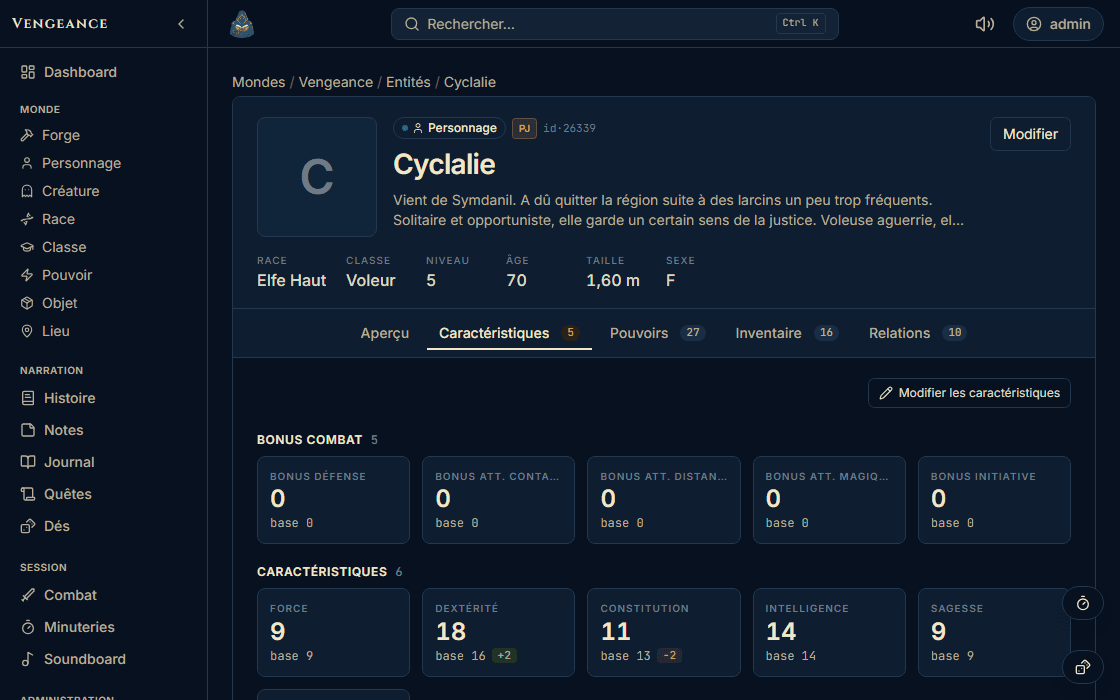
- Attributes, skills, hit points, defence, initiative: everything derived from something else is worked out by a formula you write yourself, without coding.
- The sheet shows the base value and the bonus separately: you can see where every point comes from.
- Inventory, equipment, purse and carried weight included: only what is equipped grants its bonuses.
- Each player edits their own sheet, from their computer or their phone. It is up to date the moment they open it again.
An example. You link the “Fighter” class to the character: its path powers appear on the sheet. He equips a chain mail: his defence goes from 12 to 16. He puts it back in his bag: it drops to 12 again. Nobody opened a calculator.
The thread of your campaign, session after session
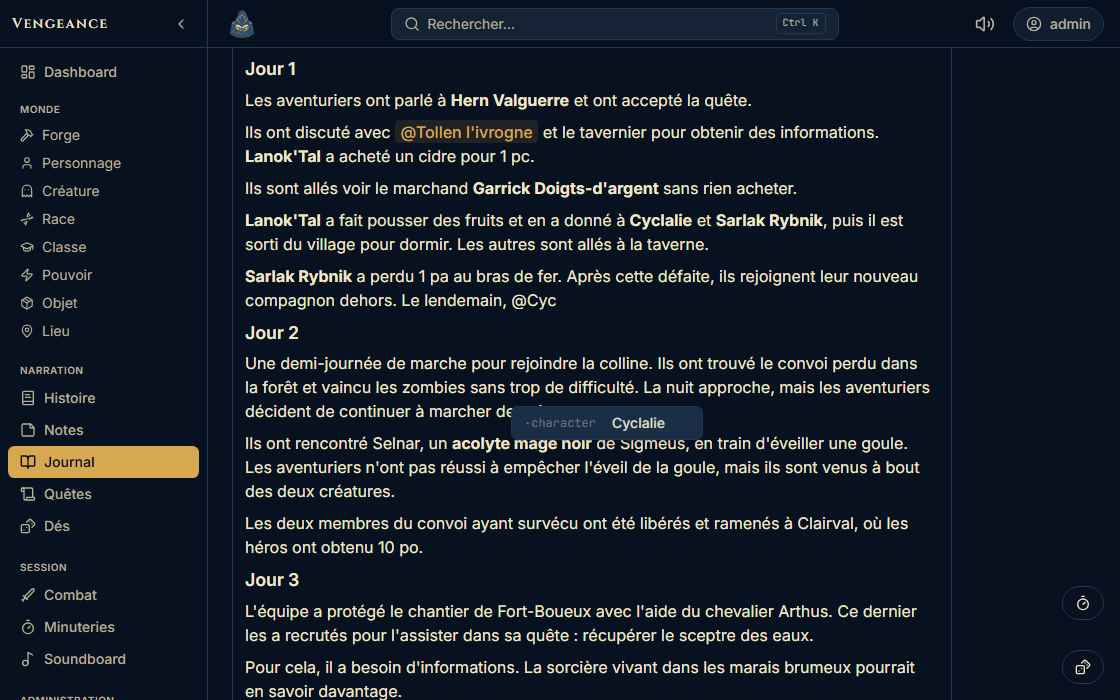
Write your recap and type @ to mention a character, a place or an item: the name becomes a link to its sheet.
- A dated journal, entry by entry. Each one visible to your players, or kept for you alone.
- Quests and sub-quests with their status, and world articles you open up as the story unfolds, with a switch per article.
- Every sheet lists the sessions, quests and articles it appears in. A year later, you find the merchant from chapter 2 without searching.
- Your world dashboard shows the quests in progress and the latest sessions, in a game master view and a player view, composed separately.
During the game, everything is already on the table
Combat, sound and timers stay in the same tab as your sheets. The dice, though, are for everyone.
Combat tracking
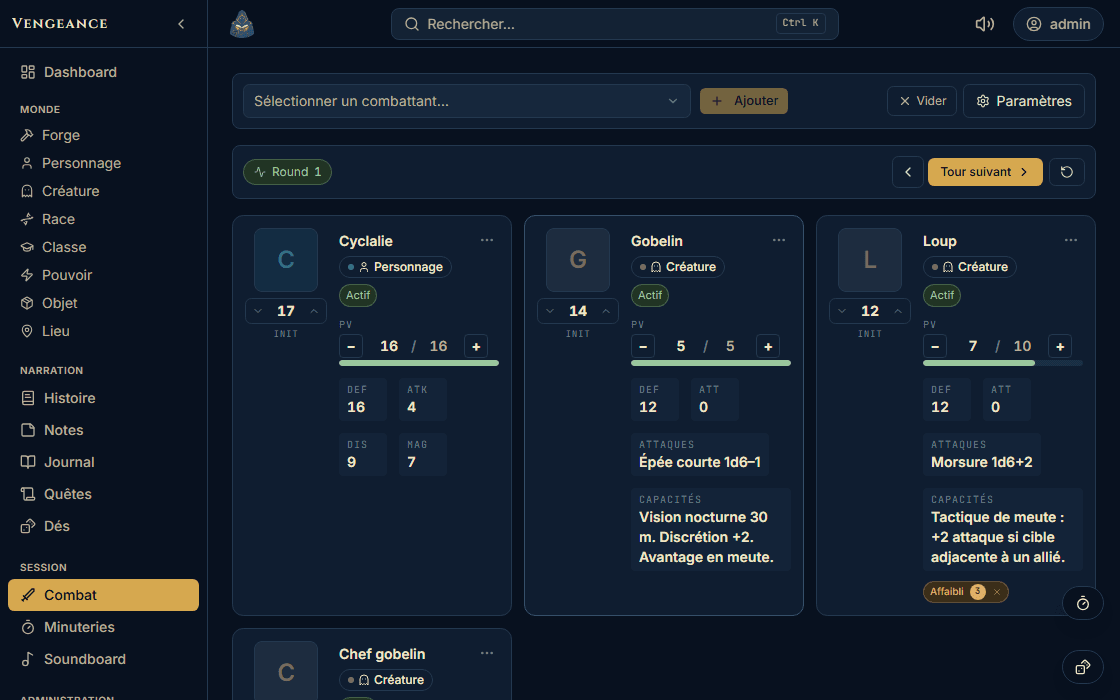
Game master onlyAdd your creatures in several copies, track hit points with a click, apply “Poisoned, 3 rounds”: the status changes the stats on display and clears itself on the right round.
Ambient sound
Game master onlyA mixing desk for your session: several sounds at once, seamless loops, your own files. The player keeps going when you change page.
Timers
Game master onlySeveral named countdowns in parallel (“the guard comes back in ten minutes”) that ring with a sound from your soundboard rather than a beep.
Dice
Game master and playersFrom d20 to full notation (2d6+3, 4d6kh3), with advantage, disadvantage, favourite rolls and history. Everyone rolls on their own device, just like with their own dice.
What everyone gains
Three jobs around the same table.
The game master
- One screen instead of six tabs, while preparing as much as during the session.
- Your house rules written once, applied to every sheet concerned. Fix a class power: the three characters who have it are up to date.
- You decide what your players see, and when: a switch per article, per journal entry, per note.
The players
- Their sheet, up to date, which they edit themselves and which recalculates without them thinking about it.
- The recap of past sessions and the codex you open to them, to read again between games.
- Their own dice, their personal notes invisible to the other players, and the “My characters” filter to find their sheet in one click.
The table, over time
- A campaign that remembers: who did what, at which session, with whom.
- A player joins at chapter 7? They read the journal and they are up to speed before the first scene.
- Nothing is locked in: everything exports, and everything imports back.
Start with a world already filled in
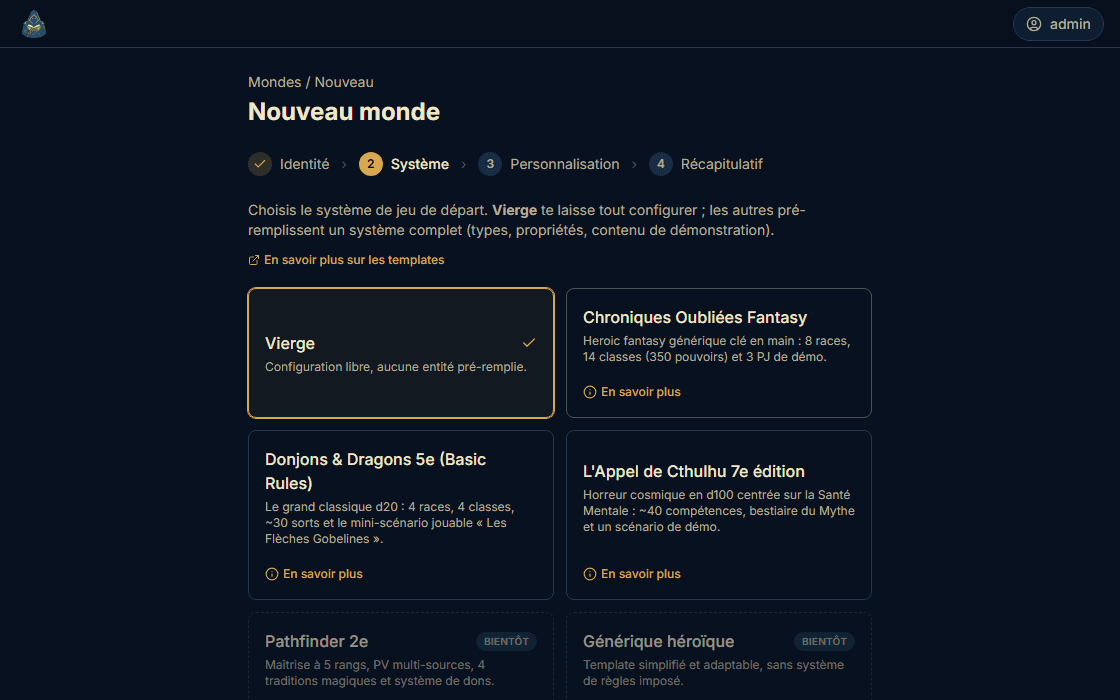
Choose a system when you create your world: it arrives with its rules, its sheets and its characters. Everything stays editable: a template is a convenience, not a commitment.
Chroniques Oubliées Fantasy
8 races, 14 classes spread across 70 paths, 350 powers, a bestiary, three currencies, and the rules summary published as articles your players can read.
Dungeons & Dragons 5e (basic rules)
4 races, 4 classes, 6 backgrounds, 18 skills, around thirty spells, and the mini-adventure “Les Flèches Gobelines”, playable as is.
Call of Cthulhu 7e
The d100, Sanity, around forty skills, the bestiary of the Mythos, the occult tomes, and the scenario “Les Murmures de Blackwood”.
Or start from a blank page
A four-step wizard walks you through your sheet types, your attributes, your currencies and your weight rules. For a house system, a hack, or a game nobody has ever put on a computer.
Already have everything in a spreadsheet? Import your sheets directly, with a file template matched to your world.
Free, in beta, and your data stays yours
Loreward is built and maintained by one person. Better to say so plainly.
It is free today. No payment method is asked for at sign-up, there is no advertising, no tracker, no analytics. So no cookie banner either. Should usage push the running costs up one day, a contribution or some paid features remain possible: the pricing page says so plainly.
It is in beta. Screens change from one version to the next and features evolve. But your worlds are not disposable data: no reset is planned. The version history is public.
It is hosted in Switzerland, with Infomaniak. Fonts and images are served from the same domain: your browser talks to nobody else.
You can leave. Export a whole world in a file that Loreward can read back as is, or each kind of sheet in a format that opens in a spreadsheet.
Frequently asked questions
Is Loreward free?
Yes. The tool is free for the whole beta period and no payment method is asked for at sign-up. There is no advertising, no tracker, no analytics. What comes next will depend on how the project grows and how many people use it: if Loreward gets heavily used and running costs rise, a contribution may be asked for, or some features may become paid. Any such change would be announced ahead of time on the pricing page.
Do my players need an account?
Yes, a free account. You invite them by email or by code, and they join your world with the role you choose: co-GM for an assistant, player for everyone else. A player sees what you share, edits their own character, takes their notes and rolls their dice.
Do I have to enter everything before I can play?
No. Choose a system when you create your world and it arrives already filled in. Chroniques Oubliées Fantasy: 8 races, 14 classes, 350 powers and the rules summary published for your players. D&D 5e: 4 classes, 18 skills, around thirty spells and a playable mini-adventure. Call of Cthulhu 7e: the d100, Sanity and the scenario “Les Murmures de Blackwood”. You can also start from an empty world.
Does it work with my game system?
Three systems ship ready to play: Chroniques Oubliées Fantasy, D&D 5e (basic rules) and Call of Cthulhu 7e. For all the others (Pathfinder, an obscure game, a house system), you define your own attributes, skills and formulas: nothing is hard-wired in the tool. A Pathfinder 2e template and a generic one are announced but not available yet.
Can I roll dice inside Loreward?
Yes, and everyone has access, players included. One click for a d20, or full notation (2d6+3, 4d6kh3), with advantage, disadvantage, favourite rolls and a history of the last twenty rolls. A floating badge follows you from page to page. Everyone rolls on their own device, just like with physical dice: it stands in for the dice, it does not referee the table.
Where is my data, and can I get it back?
Your worlds are private, restricted to their members, and hosted in Switzerland with Infomaniak. You can export a whole world at any time in a file that Loreward can read back as is, or each kind of sheet in a format that opens in a spreadsheet. The details are on the Privacy page.
Learning your way around
Twenty-two step-by-step guides, written to be read before you open the app.
The guides are only available in French for now.
- Bienvenue dans LorewardVue d'ensemble de l'outil et de la navigation pour bien démarrer.
- Créer un mondeCréer un univers, vierge ou à partir d'un modèle de système de jeu.
- Types d'entités & propriétésCréer et configurer les types d'entités, leurs propriétés, catégories et tags.
- Inviter des joueurs & gérer les rôlesInviter des joueurs, leur attribuer un rôle et lier un personnage.
Ready to take up the watch over your world?
Create your first world in a few minutes: empty, or already filled in with your table's system.
Loreward